Marine electronics · 14 min read · Updated 2026-09-18
Raymarine vs Garmin vs Simrad vs Furuno in Australia
Four families still dominate Australian helms. The useful differences are mapping, sonar, autopilot heritage and who will answer the phone in Queensland.
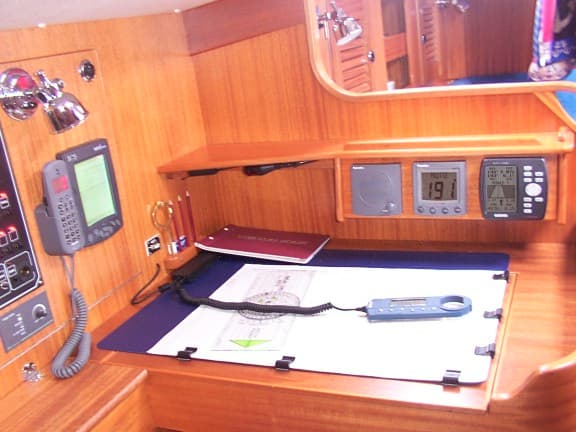
Photo: Chart table on a Hallberg-Rassy 36 with GPS, NMEA instruments and DSC VHF by Pete Verdon. Licensed under CC BY-SA 3.0. Source on Wikimedia Commons. Also listed on the AM Wholesale image credits page.
Ask an Australian yard to name a helm and you will hear four words: Raymarine, Garmin, Simrad, Furuno. The archived AM Wholesale brand wall said the same. This is not a “winner” piece. It is a map of where each family still earns a place on an Australian boat.
If you do not yet know whether you need a plotter or an MFD, start with chartplotter versus fishfinder versus MFD. If the network is the risk, read the NMEA 2000 refit guide first.
Raymarine
Raymarine still owns a lot of Australian sailing and mid-size power boats because the autopilot heritage (and the older SeaTalk world) is everywhere in second-hand inventories. Axiom-class glass is the current face of that. Strengths: sailing instruments, thermal cameras in the same family, and a dealer network that already knows the boat you just bought.
Weaknesses: some mixed-brand Ethernet jobs become a weekend of adapters, and older SeaTalk1 systems need a planned gateway rather than a hopeful tee.
Garmin
Garmin is the default on many Australian trailer boats and a growing number of flybridges because the sonar story is easy to demonstrate on a shop bench. GPSMAP and echoMAP units, plus the Panoptix and Livescope families, made “see the fish” a retail sentence. Charting is competent; the constraint is usually the card plan and whether you want Garmin’s network for radar.
If you already live in Garmin watches and a car, the interface tax is lower. That is not a technical argument, but it is why a lot of 6-metre boats leave Coomera with a Garmin bezel.
Simrad / Navico heritage
Simrad (and the wider Navico family that also includes B&G on the sailing side) shows up on Australian power boats that want a wide, bright helm and a straightforward autopilot story. NSS and NSO-class systems are common on 30- to 50-foot flybridges. The chart conversation in Australia often lands on C-MAP, which is covered in Navionics versus C-MAP.
The risk is treating “Simrad” as interchangeable with every other Navico sticker on a used boat. Confirm the software generation and the autopilot computer before you promise a drop-in screen.
Furuno
Furuno is the commercial and serious-cruiser answer. Australian commercial skippers already trust the radar and the sounder. NavNet-class systems cost more on the invoice and usually less in the “why is the overlay two boat-lengths out” phone call. If you run at night, carry passengers, or simply want a radar pedigree, Furuno stays on the shortlist.
It is not the impulse buy on a 5-metre tinny. It is the brand you specify when the boat is a workplace.
How Australian buyers should actually choose
- What already lives on the boat. Autopilot computers and transducers decide more jobs than bezels.
- Who will service it. A Gold Coast or Brisbane dealer you can walk into beats a slightly cheaper grey import with no local warranty path.
- The sensor package. Radar, heading, AIS and sonar matter more than a 2-inch diagonal jump. See the electronics package planner.
- The chart you will keep current. A beautiful MFD on an expired card is a fishfinder.
None of these houses is “the wholesale brand”. The old desk stocked them because Australian yards specified them. Your job is to specify the network, the sensors and the person who will still answer in March.
Frequently asked questions
- Which brand is best for the Great Barrier Reef?
- The brand matters less than the chart card, the heading sensor and a dealer who will still talk to you in Townsville. Furuno and Garmin both have strong Australian commercial followings. Raymarine and Simrad remain common on sailing and power cruisers. Buy the support path.
- Can I mix brands on one helm?
- On NMEA 2000, yes for the shared sentences. For sonar, radar and autopilot control you usually stay inside one family so the Ethernet backbone and the control heads match. A mixed helm is a gateway job, not a saving.
- Is there a true wholesale price difference between the four?
- Trade pricing moves with the Australian distributor of the day, not with the colour of the bezel. The old AM Wholesale list stocked all four because yards specified all four. Shop the package — transducer, radar, cards and warranty — not the screen-only special.