Marine electronics · 11 min read · Updated 2026-09-02
Chartplotter vs fishfinder vs MFD for Australian skippers
The three boxes look similar on a chandlery wall. On an Australian helm they do different jobs — and buying the wrong one is still the most expensive first mistake.
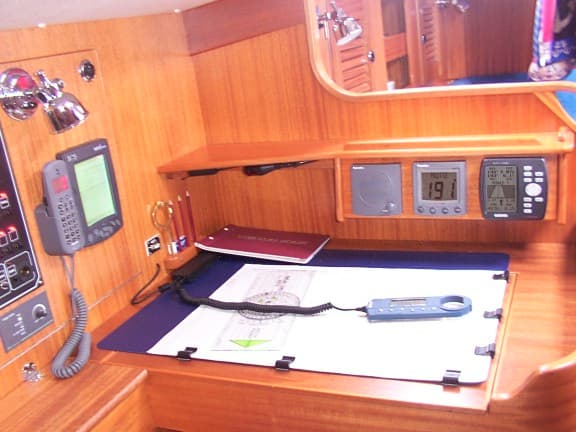
Photo: Chart table on a Hallberg-Rassy 36 with GPS, NMEA instruments and DSC VHF by Pete Verdon. Licensed under CC BY-SA 3.0. Source on Wikimedia Commons. Also listed on the AM Wholesale image credits page.
Australian search still treats “GPS”, “sounder” and “plotter” as interchangeable. Yards do not. A chartplotter is a cartographic computer. A fishfinder is a sonar computer. A multifunction display (MFD) is the glass that can host both, plus radar, cameras and engine data, if you pay for the sensors.
The old Coomera wholesale desk sold all three because a 5.8-metre yellowfin and an 18-metre flybridge do not share a helm. This guide is the naming piece. Read it before the brand comparison or the NMEA 2000 refit guide.
What a chartplotter actually does
A chartplotter takes a GNSS position and draws it on a licensed chart. The useful extras are waypoints, routes, tides, AIS overlay and a heading sensor so the boat symbol points the way the bow is pointing, not the way the keel last slipped.
On Australian water the chart is the product. Moreton Bay, the Broadwater, Port Phillip heads and the inner Great Barrier Reef all punish a unit that cannot load a detailed card or an up-to-date subscription. A cheap handheld GPS will give you a lat/long. It will not tell you that the beacon you are aiming at has a drying bank on the flood.
If your job is “do not hit the sandbank at night”, you want a chartplotter or an MFD with a current Australian chart. You do not want a fishfinder with a cartoon map.
What a fishfinder actually does
A fishfinder drives a transducer and paints a water column. Traditional 50/200 kHz units still work. CHIRP units, especially with a decent Airmar or branded in-hull or transom transducer, show bait, thermoclines and bottom hardness that a plotter cannot invent.
Trailer-boat fishers on the Gold Coast, Lake Macquarie and the Gippsland Lakes often need the sonar more than the chart. That is a legitimate first buy — as long as you are honest about night navigation. Many “combo” 7-inch units are a fishfinder with a thin chart layer, not the other way around.
For transducer theory, continue to CHIRP transducers and Airmar.
What an MFD changes
An MFD is not a third category of physics. It is a networked glass helm. The same 12- or 16-inch display can show a C-MAP or Navionics chart, a CHIRP page, a radar overlay and a camera. The cost moves from the screen to the backbone: NMEA 2000, Ethernet or manufacturer backbone, heading sensor, radar pedestal, and a power system that will not brown out when the radar and the sounder both ping.
That is why the 30- to 50-foot electronics package starts with power and network, not with the brochure diagonal.
A practical Australian decision tree
- Tinny or 5-metre trailer boat, daylight fishing: a quality fishfinder/combo with a transom transducer. Keep a handheld VHF and a phone GPS as backup, not as the plan.
- 6- to 8-metre trailer boat that crosses a bar: a combo MFD of at least 9 inches, a heading sensor if you can, and a chart card you actually update. See GPS plotter installation mistakes.
- Cruising yacht or flybridge: an MFD as the helm computer, a dedicated sonar if you fish, and radar if you move at night or in shipping. Pair this with the radar guide and AIS Class A versus Class B.
Why the old wholesale list still matters
Raymarine, Garmin, Simrad and Furuno all sell boxes that can wear any of the three labels. The difference in the yard is support, transducer families and whether your existing NMEA 0183 autopilot can be talked into the new glass. A “cheap MFD” that cannot share a heading sentence is a fishfinder with a pretty map.
If you are still choosing a family, read the Raymarine, Garmin, Simrad and Furuno comparison. If the boat already has a blue backbone, start with NMEA 2000 for Australian refits.
Frequently asked questions
- Can a fishfinder replace a chartplotter on Moreton Bay?
- Only if you already know the water and you accept that you will not have a cartographic position overlay, waypoints or AIS targets on that screen. For a night exit through the Gold Coast Seaway or a first trip to the Wide Bay bar, that is the wrong compromise.
- Is a 7-inch MFD enough for a 7-metre trailer boat?
- Yes, if it is the only helm screen and you are not splitting sonar and chart. Once you add radar or want a dedicated sonar page, a 9-inch or a second smaller display is the usual Australian trailer-boat upgrade.
- Do I need NMEA 2000 if I only want a plotter?
- Not on day one. You will need it the moment you add a heading sensor, AIS, autopilot or a radio that should share an MMSI and GPS position. Plan the backbone even if you buy the drop cables later.