Comms and safety · 11 min read · Updated 2026-09-06
Night vision and thermal cameras for Australian boats
Low-light cameras show a scene. Thermal cameras show heat. Iris-style marine cameras earn a place on a night run; they do not replace a lookout or a radar.
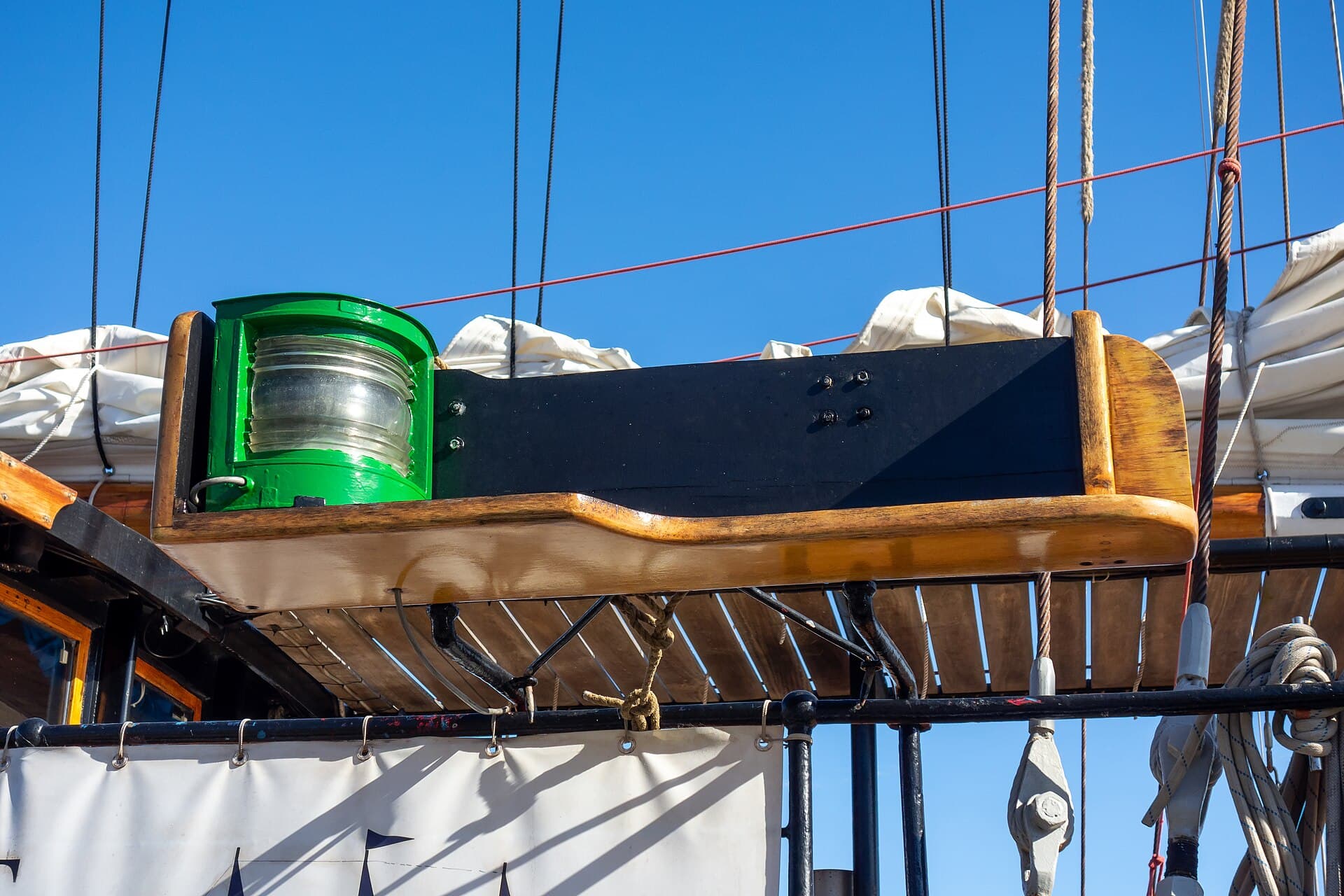
Photo: Green navigation light on schooner Älva by W.carter. Licensed under CC BY-SA 4.0. Source on Wikimedia Commons. Also listed on the AM Wholesale image credits page.
The archived AM Wholesale catalogue made Iris Innovations night-vision and marine cameras a headline brand, beside FLIR and a pile of analogue, IP, low-light and thermal housings. That was not window dressing. Night on the Broadwater, the Brisbane River and a bar crossing is a visibility job. Cameras help. They do not replace navigation lights, a lookout, or radar.
Low-light versus thermal
Low-light / near-IR cameras need some photons. They show a picture you can interpret as a picture: a beacon, a hull, a pontoon. They struggle in true dark and in rain.
Thermal cameras see heat. A person, an exhaust, a warm rock at dusk. They are excellent at “something living or recently running is there”. They are poor at reading a sign or a lead light’s colour.
Many serious night helms want both, or a unit that can overlay. That is an Iris / FLIR-class conversation, not a doorbell camera.
Where cameras earn their keep
- Engine room: smoke, belts, water in the bilge. A fixed, heat-tolerant camera you glance at from the helm.
- Cockpit and side decks: man-overboard and docking. Useful on a flybridge that cannot see its own wings.
- Forward night running: thermal or low-light on a stabilised mount, watched with the eyes, not instead of them.
- Security: the marina version, which is a different wiring and recording job.
Network and power
IP cameras want Ethernet and a switch that will live in a damp locker. Analogue cameras want a proper run, not a leftover TV cable. Put the display on the MFD if the family supports it — see the brand comparison — or on a dedicated monitor that dims. Cameras are a 12-volt load. Add them to the power study.
What not to do
Do not dim the nav lights so the camera looks cinematic. Do not steer by a 7-inch thermal while the radar sits on a demo page. Do not skip AIS because you bought a camera. A thermal blob without a heading overlay is a campfire story.
If the rest of the night kit is still open, use the radar guide and spreader lighting so the camera is the third sensor, not the first.
Frequently asked questions
- Will a thermal camera see an unlit tinnie?
- Often, yes, as a warm outboard and a warmer skipper against colder water. It will not see a log, a star picket or a mooring line. Thermal is a sensor, not a superpower.
- Do I need a gyro-stabilised PTZ?
- On a 40-foot flybridge that runs at night, a pan-tilt-zoom thermal or low-light unit is the product the old Iris desk was built around. On a 6-metre trailer boat, a fixed engine-room or cockpit camera is the useful first camera.
- Can I use a car dash-cam at the helm?
- You can, and salt will eat it. Marine cameras are sealed, powered and networked for a reason.