Watermakers · 13 min read · Updated 2026-09-12
How to choose a yacht watermaker in Australia
Size from litres per day and hours you will actually run the pump, not from a US-gallon sticker. Power, space and tropical maintenance decide the rest.
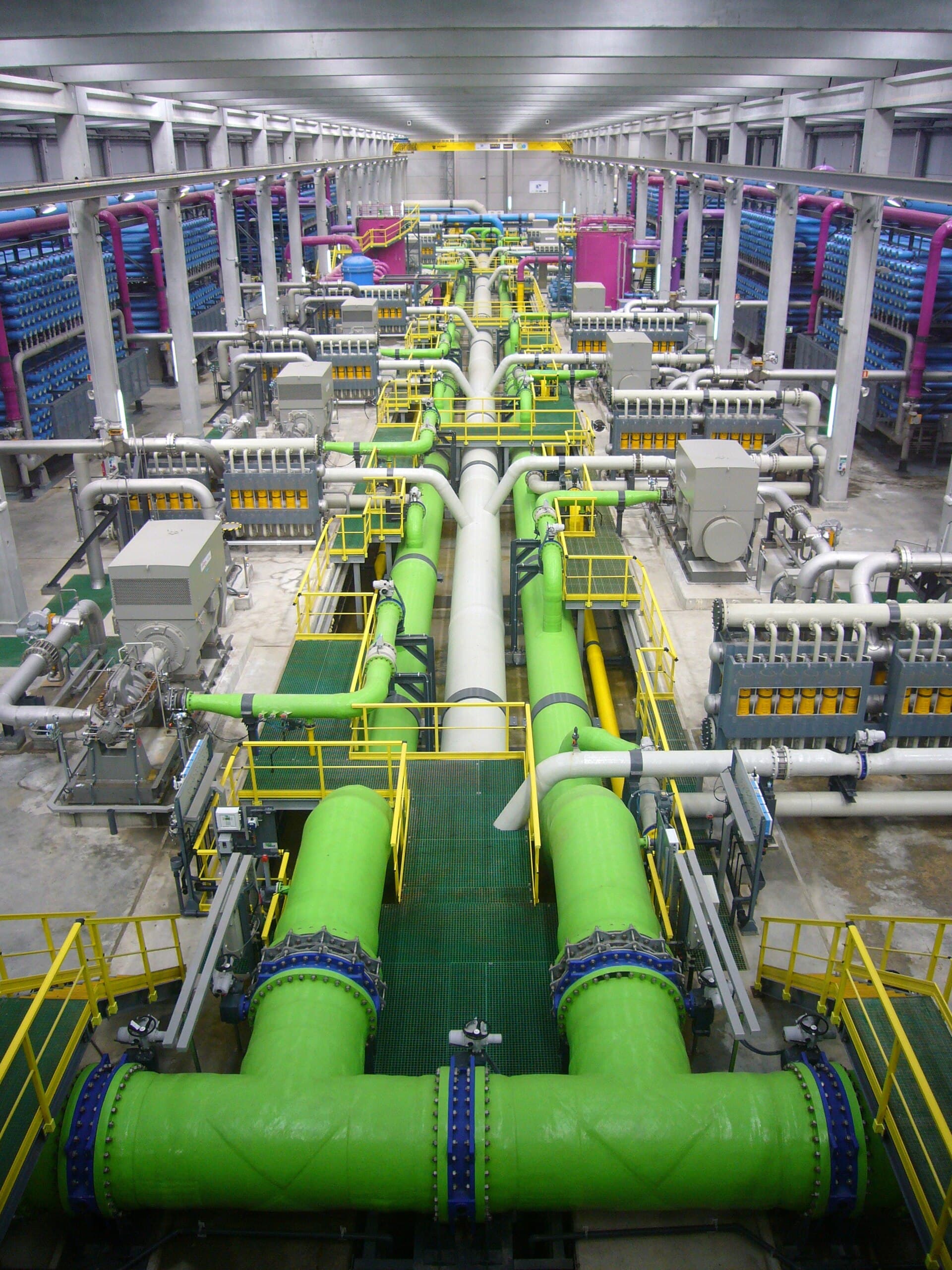
Photo: Reverse osmosis desalination plant by James Grellier. Licensed under CC BY-SA 3.0. Source on Wikimedia Commons. Also listed on the AM Wholesale image credits page.
Australian Marine Wholesale was the exclusive Australian distributor of Blue Water desalination and also listed Pacific Light. That is why this journal still treats a watermaker as a first-class specification, not a luxury footnote. Reverse osmosis is a high-pressure pump, a membrane and a lot of pre-filtration. The brand on the frame matters less than litres, power, space and whether you will pickle the membranes in the Wet Tropics.
Convert the sticker
US-gallon-per-day ratings still dominate brochures. Multiply by 3.785, then divide by the hours you will actually run the unit. A “400 GPD” machine is about 1,500 litres per day if it runs for 24 hours. You will run it for two. That is 125 litres, which may be perfect.
The companion piece how much fresh water a cruising yacht needs is the demand side of this sum.
Power before plumbing
High-pressure pumps are the load that surprises people who just finished a pretty electronics refit. Put the motor on the same study as the inverter and the house bank. See Victron systems and inverter sizing. A 12-volt 30-litre-an-hour unit and a 240-volt 120-litre-an-hour unit are different boats.
Space, noise and service
- Compact frames suit a single locker if you can still change pre-filters without yoga.
- Modular systems suit older cruisers whose lockers are already full of NMEA backbones and battery boxes.
- Automatic fresh-water flush is not a luxury in Queensland. It is how membranes survive.
If you are choosing between the two families the old desk imported, continue to Blue Water versus Pacific Light.
Seawater quality
Reverse osmosis wants clean, cold-ish, oil-free seawater. Anchoring in the Coomera River after rain is not a production window. Estuary silt and tropical bloom are why pre-filters and a proper intake strainer exist. The maintenance piece is watermaker care in tropical Queensland.
What to ask a dealer
Where is the Australian parts stock? Who pickles a unit that sat for six months? What is the real, measured output in 25-degree water, not the brochure’s 15-degree fantasy? A watermaker is a relationship with a service agent. The old Coomera exclusive-import model existed because that relationship was the product.
Frequently asked questions
- How many litres per hour do I need on a 40-foot cruiser?
- Enough to replace what you drink, wash and cook in the hours you are willing to hear the pump. For many couples that is 40 to 80 litres per hour, run in the morning. See the companion piece on daily water budgets.
- Compact or modular?
- Compact if you have one locker that can take the frame, the noise and the service access. Modular if the boat is already full and you can spread pre-filters, pump and membranes. The old Blue Water list sold both for that reason.
- 12-volt or 240-volt?
- 12-volt (or 24) for modest output on a DC-rich boat. AC for higher output if you already run a generator or a large inverter. Do not invent a 240-volt watermaker on a 12-volt bank and a 500-watt inverter.